 Mystic Seaport notes with sadness the passing of Nancie Greenman, long-time volunteer in the Interpretation Department and friend of Mystic Seaport. Nancie died in September 2013.
Nancie was an associate professor at and former chair of the Boston School of Occupational Therapy at Tufts University.
A member of Mystic Seaport since 1955, she was a Pilot for six years and credits the PILOTS program with her decision to move to Mystic in 1979 after her retirement.
Using her teaching background as a base, Nancie welcomed the opportunity to pursue a second career, that of museum work. She became an active volunteer, donating thousands of hours of volunteer service as an Interpreter in the Mallory, Stillman, and Schaefer Buildings. She joined the Library Fellows in 1990 and was also a Life Member and Stillman Society member.
Nancie was a lively conversationalist – bright and perceptive, with a no-nonsense personality. She was highly respected by her friends and colleagues in the Interpretation Department and across the Museum.
Her great grandfather was Captain John Bolles, a whaleman who sailed out of New London. A large number of his logbooks have been preserved in the Manuscript Collection of the G.W. Blunt White Library. Nancie’s family background and personal interest in maritime history also led her to become involved in the International Congress of Maritime Museums.
Thanks to Claire Calabretta for compiling this information about Nancie
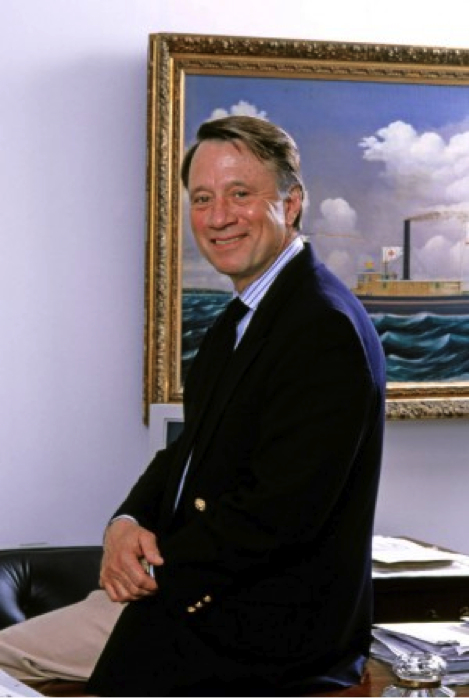 The man who expanded the Mariners' Museum in Newport News, Virginia, USA, and oversaw construction of its acclaimed Monitor Center has died.
John B Hightower, 80, died on 6th July 2013.
Hightower directed three maritime museums, transformed a sleepy state arts commission into a national powerhouse and was at one time was the youngest head of the Museum of Modern Art in New York.
He remained active in the public arts and culture world after his retirement from the Mariners' Museum, serving as director of the Downing-Gross Cultural Arts Center during the final troubled months before it opened in 2008, and also as a board
John Hightower came to Hampton Roads in 1993 to become president and CEO of the Mariners' Museum after serving as director of planning and development for the arts at the University of Virginia, where he had been for four years. Under his leadership, the museum grew to include the Defending the Seas gallery, the $1.4 million Small Craft Center and the jewel in the group, the $30 million Monitor Center, opened in 2007.
"He was wonderful to work with," said Marge Shelton, assistant to the president of the Mariners' Museum. Shelton worked for Hightower from 1998-2006. "He had a very good sense of humor. We laughed almost every day.”
Anna Holloway, the Monitor Center curator and the vice president of collections and programs at the museum, said Hightower believed in the museum's ability to expand, to care for and display artifacts from the Civil War ironclad Monitor when, in the late 1990s, the Navy and the National Oceanic and Atmospheric Administration sped up recovery efforts.
]]>A little bit of background: The AHRC is the body that funds university research in the humanities and in 2006 it extended the opportunity to apply for academic funding to a small number of museums, galleries and archives, the National Maritime Museum being one. In 2010, the Museum received one of the largest AHRC grants ever given when it successfully applied with the University of Cambridge for a project to explore the history of the Board of Longitude – the Board that was set up in 1714 to find a solution to the problem of finding longitude at sea. Cambridge and the Museum have already held a number of seminars and workshops in the UK and, with the generous support of one of the project partners, the Huntington Library in Pasadena, in the USA. A conference and special exhibition are scheduled in Greenwich for the summer of 2014. ]]>
Michael Stammers BA FSA, who died on 30 January 2013 after a period of illness, was outstanding among his generation of maritime curators for his energy and diligence; qualities tested over the several years that it required to establish the Merseyside Maritime Museum in the long-neglected Albert Dock complex at Liverpool.
Born in Norfolk UK, Mike arrived in Liverpool in 1969 as Assistant Keeper of Shipping & Transport under Edward Paget-Tomlinson. He led the team that prepared new Land Transport Galleries, opened in 1972, and attended the inaugural Congress of ICMM at Greenwich later that year. Following the rescue of Brunel’s ss Great Britain from the Falkland Islands, Mike made several visits to Port Stanley to investigate and record other historic sailing ships abandoned there, including the Canadian Actaeon of 1838, the British-built Vicar of Bray (1841) and Jhelum (1849) and the American clipper Snow Squall of 1851. Having crawled all over these ships, he used his findings in a seminal paper on Iron knees in wooden vessels, published in the International Journal of Nautical Archaeology in 2001. ]]>
Contributed by John Robinson, UK
Between 1901 and 1905 no less than 69 three-masted fishing vessels were registered at Fécamp in Normandy, France, a natural harbour whose ancient name Fiscannum derives from the term fisk used by the Scandinavian seafarers who had been regular visitors since antiquity.
Fécamp shipyards built many fine vessels in the last century, including the French Navy's two sail training vessels L'étoile and La Belle Poule, still in service after 80 years. Can any other sail training vessel rival this length of service continuously in the same ownership? Presumably their active sail training role was interrupted by WWII.
For much of the last century, Fécamp landed most of France’s harvest from the Grand Banks of Newfoundland. From 1931 power-driven trawlers began to oust the cod schooners. The life remained hard for those who fished in those hazardous North Atlantic waters, as recorded in the work of documentary photographer and oceanographer Anita Conti, who sailed with them to the Grand Banks on two occasions.
Calls to limit the catch to sustainable levels went unheeded, and from about 1980 the Grand Banks cod fishery was exhausted. The last French trawler quit Fécamp in 1987.The town has hitherto presented the story of its fishing industry in its Musée des Terres Nuevas, a compact but comprehensive museum on the seafront housing a complete fishing boat. But that institution is now closing its doors, preparatory to opening a much larger Musée des Pecheries adjacent to the former fishing harbour in an imposing industrial building dating from 1950. Work has now finished on a steel-framed ‘belvedere’ on the roof which will house an introductory gallery and provide visitors with striking views of the dock basins (now heavily used by leisure sailors)and the tall chalk cliffs that flank the harbor entrance. The new Museum of Fisheries is scheduled to open in 2013.


Much of the €13.5m budget for this impressive transformation has come from regional, national and European support funds. The new museum is a principal component in the strategy to promote Fécamp as a year-round tourist destination, and will broaden the town’s appeal beyond the Benedictine distillery and museum that is currently the main attraction. Local residents are assured that, with a doubling or tripling of annual visits compared with the existing museum, there will be no adverse impact on the town’s finances. The smaller building on the seafront will become a Médiatheque.
For further details, see: http://www.ville-fecamp.fr/Musee-des-Pecheries-le-chantier.html

]]>